
German Volume Training Workout Plan: A Comprehensive Guide
This guide details a rigorous 6-week program, dividing workouts into chest/back, legs/abs, and arms/shoulders,
specifying exercises, sets, repetitions, tempo, and crucial rest intervals for optimal results.
What is German Volume Training (GVT)?
German Volume Training, often abbreviated as GVT, is a high-volume strength training protocol designed to induce significant muscular hypertrophy. It centers around performing 10 sets of 10 repetitions for a chosen exercise, utilizing a weight that is approximately 60% of your one-repetition maximum (1RM). This method isn’t about maximal strength gains, but rather about creating substantial metabolic stress and muscle damage, prompting a robust recovery response and subsequent muscle growth.
The core principle lies in the sheer volume of work performed. This intense stimulus forces the muscles to endure prolonged periods of tension, depleting glycogen stores and creating a powerful anabolic environment. GVT is typically structured as a full-body or split routine, focusing on compound exercises to maximize its effectiveness. It’s a demanding program, requiring careful attention to nutrition and recovery to prevent overtraining and ensure optimal results.
The History and Origins of GVT
German Volume Training’s roots trace back to the 1980s, specifically to the work of German coach Wolfgang Scziborra. He developed the protocol to rapidly improve the performance of his weightlifting athletes, particularly leading up to competitions. Scziborra observed that a high-volume approach, centered around the 10×10 repetition scheme, effectively stimulated muscle growth and enhanced work capacity.
Initially, GVT wasn’t widely publicized, remaining a closely guarded secret within the German weightlifting community. However, it gained international recognition through articles in Strength Training Review in the early 1990s, penned by Stuart McRobert. McRobert’s detailed accounts of the program’s effectiveness sparked considerable interest among bodybuilders and strength enthusiasts worldwide. The method quickly became popular for its ability to deliver noticeable results in a relatively short timeframe, establishing itself as a cornerstone of hypertrophy training.

The Core Principles of GVT
German Volume Training fundamentally revolves around maximizing metabolic stress and muscle fiber recruitment. The cornerstone is performing 10 sets of 10 repetitions for a chosen exercise, utilizing a weight that’s approximately 60% of your one-rep maximum (1RM). This high volume creates significant lactate buildup, promoting hormonal responses conducive to muscle growth.
Central to GVT is the emphasis on compound exercises – movements that engage multiple muscle groups simultaneously. These exercises, like squats, deadlifts, and bench presses, are prioritized to maximize overall muscle stimulation. Rest periods are deliberately kept short, typically between 60-90 seconds, further amplifying metabolic stress. The program is structured to target specific muscle groups each session, allowing for adequate recovery between workouts.
The 10 Sets of 10 Reps Protocol
The defining feature is completing ten sets of ten repetitions with a consistent weight, aiming for roughly 60% of your one-rep max for substantial muscle hypertrophy.
Understanding the 10×10 Method
The 10×10 method, central to German Volume Training, involves performing ten sets of ten repetitions for each exercise. This isn’t about maximal weight; instead, it focuses on a weight you can manage for all ten sets while maintaining good form. The goal is metabolic stress and muscle fatigue, driving hypertrophy.
Initially, selecting the correct weight is crucial. It should be challenging but allow you to complete all reps with proper technique. Don’t prioritize ego lifting; focus on controlled movements. As you progress, slight weight increases are permissible, but only if form isn’t compromised. The cumulative volume – 100 repetitions per exercise – is the key stimulus.
This high volume creates significant metabolic stress, leading to a substantial pump and promoting muscle growth. It’s a demanding protocol, so proper preparation and recovery are essential for success and injury prevention; Expect fatigue, and listen to your body.
Choosing the Right Weight for GVT
Selecting the appropriate weight is paramount for successful German Volume Training. The aim isn’t to lift your one-rep max; it’s to choose a weight that allows you to complete all ten sets of ten repetitions with reasonably good form. A common guideline is to use approximately 60-70% of your one-rep max for a given exercise.
Start conservatively. It’s better to underestimate initially than to fail before completing all sets. If you can easily perform all ten sets, slightly increase the weight in the next workout. However, if you struggle to maintain form, reduce the weight. Prioritize technique over ego.
The weight should feel challenging by the final sets, inducing significant muscle fatigue. Remember, the volume is the primary driver of hypertrophy, not maximal load. Consistent form throughout all 100 reps is vital for maximizing results and minimizing injury risk.
Rest Periods and Tempo in GVT
Precise rest periods and tempo are crucial components of the German Volume Training protocol. Rest between sets should be kept relatively short, typically around 60-90 seconds. This limited rest contributes to metabolic stress and muscle fatigue, key factors in GVT’s effectiveness. Avoid excessively long rest periods, as they diminish the intended stimulus.
Regarding tempo, a controlled cadence is recommended. A common suggestion is a 4-0-2-0 tempo – four seconds for the eccentric (lowering) phase, no pause, two seconds for the concentric (lifting) phase, and no pause at the top. This controlled tempo maximizes time under tension.
Focus on maintaining proper form throughout each repetition, even as fatigue sets in. Don’t sacrifice technique for speed. Consistent tempo and short rests amplify the metabolic demand, driving significant muscle growth.

A Sample 6-Week GVT Workout Plan
This structured plan progresses over six weeks, strategically dividing workouts and adjusting intensity. It focuses on chest/back, legs/abs, and arms/shoulders, maximizing gains.
Week 1-2: Building a Foundation
The initial two weeks of the German Volume Training (GVT) plan are dedicated to establishing a solid base. This phase prioritizes proper form and muscular endurance before significantly increasing the load. Workouts are split into three distinct sessions: Chest & Back, Legs & Abs, and Arms & Shoulders. Each session involves performing 10 sets of 10 repetitions for each exercise, utilizing a controlled tempo – typically 4-0-2-0 (4 seconds eccentric, no pause, 2 seconds concentric, no pause).
Rest periods between sets should be kept relatively short, around 60-90 seconds, to maintain metabolic stress. Focus on selecting a weight that allows you to complete all 10 sets with good form, even if it means starting lighter than you anticipate. This foundational period is crucial for preparing your muscles and nervous system for the more intense weeks to come, minimizing the risk of injury and maximizing long-term progress.
Chest & Back Workout (GVT)
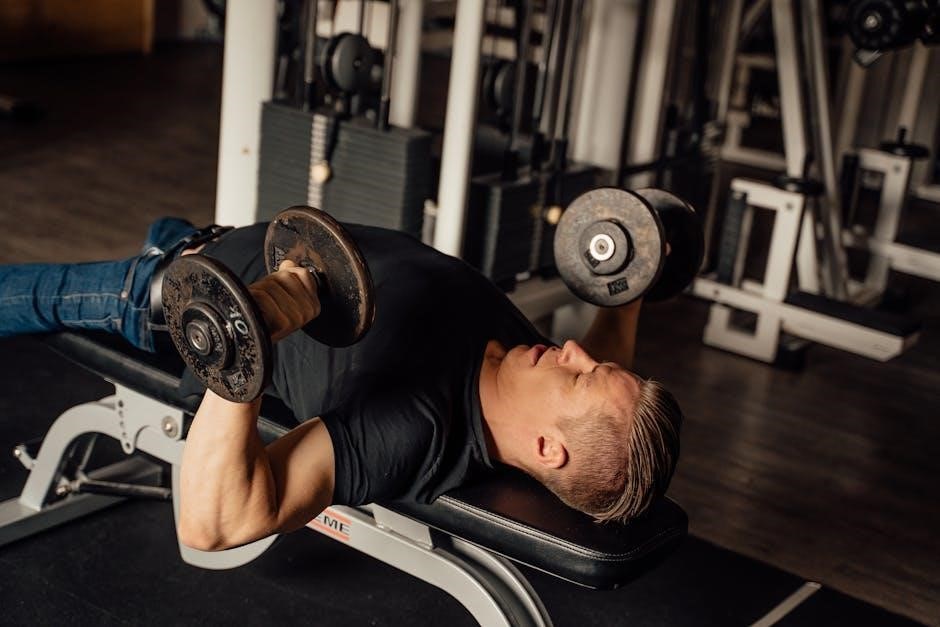
For the Chest & Back session during Weeks 1-2, the focus is on compound movements to maximize muscle fiber recruitment. Begin with Incline Dumbbell Press (10 sets of 10 reps), followed by Flat Bench Press (10×10). Next, incorporate Dumbbell Flyes (10×10) to target the chest from a different angle. Transition to back exercises with Pull-Ups (aim for 10 reps per set, assisted if needed) and Barbell Rows (10×10).
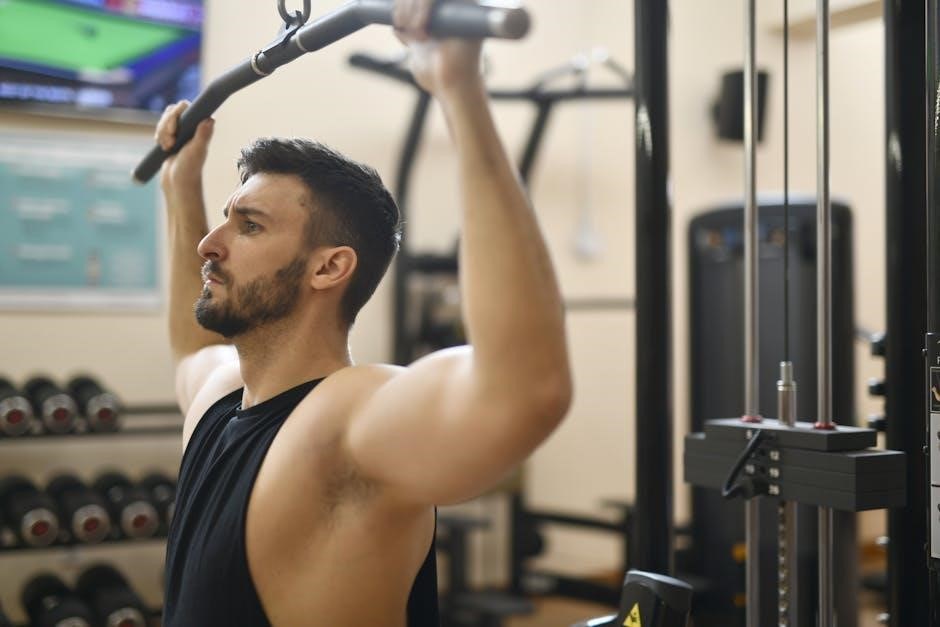
Finish with Lat Pulldowns (10×10) to fully exhaust the back muscles. Maintain a consistent tempo of 4-0-2-0 throughout each exercise, and adhere to 60-90 second rest intervals. Prioritize controlled movements and proper form over lifting excessively heavy weight. This foundational approach builds a solid base for increased intensity in subsequent weeks, preparing the muscles for heavier loads and greater volume.
Legs & Abs Workout (GVT)
The Legs & Abs workout, spanning Weeks 1-2, emphasizes building lower body strength and core stability. Initiate the session with Barbell Squats (10 sets of 10 reps), a cornerstone exercise for overall leg development. Follow this with Leg Press (10×10) to further challenge the quadriceps, hamstrings, and glutes. Include Leg Extensions (10×10) to isolate the quads and Hamstring Curls (10×10) for hamstring development.
Conclude the leg portion with Standing Calf Raises (10×10). For the abs, perform Crunches (10×10), Leg Raises (10×10), and Plank (3 sets, holding for as long as possible with good form). Maintain a 4-0-2-0 tempo and 60-90 second rest periods. Focus on controlled movements and proper technique to prevent injury and maximize muscle engagement throughout this demanding workout.
Arms & Shoulders Workout (GVT)
The Arms & Shoulders workout, designed for Weeks 1-2, focuses on building upper body mass and strength. Begin with Shoulder Press (10 sets of 10 reps) to target the deltoids. Follow with Lateral Raises (10×10) to emphasize the medial deltoid, and Front Raises (10×10) for the anterior deltoid. Incorporate Bent-Over Rows (10×10) to build rear deltoid and upper back strength.
Transition to arm work with Barbell Curls (10×10) for biceps development, and Close-Grip Bench Press (10×10) to target the triceps. Finish with Hammer Curls (10×10) for brachialis and forearm development. Utilize a 4-0-2-0 tempo and 60-90 second rest intervals. Prioritize controlled movements and proper form to ensure effective muscle stimulation and minimize the risk of injury during this intense session.
Week 3-4: Increasing Intensity
Weeks 3 and 4 mark a crucial phase of increased intensity within the 6-week German Volume Training program. The primary adjustment involves increasing the weight used for each exercise, while maintaining the core 10 sets of 10 repetitions protocol. This progressive overload is key to continued muscle growth and strength gains.
Focus on selecting a weight that challenges you to complete all 10 reps with good form, but pushes you close to muscular failure by the final set. Rest periods remain consistent at 60-90 seconds between sets. Monitor your performance closely and adjust the weight accordingly if needed. Remember, maintaining proper technique is paramount, even as the load increases. This phase demands heightened focus and dedication to maximize results.
Chest & Back Workout (GVT) ⎯ Increased Weight
During weeks 3 and 4, elevate the weight utilized for both chest and back exercises while adhering to the 10 sets of 10 repetitions structure. For chest, consider exercises like bench press, incline dumbbell press, and decline dumbbell press, increasing the load from the previous weeks. Back work should include pull-ups (assisted if necessary), barbell rows, and seated cable rows, again with increased weight.
Maintain a tempo of 4-0-2-0 (4 seconds eccentric, no pause, 2 seconds concentric, no pause) and 60-90 seconds rest between each set. Prioritize controlled movements and proper form over lifting excessively heavy weight. This phase aims to stimulate further muscle hypertrophy through progressive overload, demanding consistent effort and attention to detail throughout the workout.
Legs & Abs Workout (GVT) ⎯ Increased Weight
Weeks 3 and 4 demand a weight increase for leg and abdominal exercises, continuing the 10×10 protocol. Focus on compound movements like squats (back or front), leg press, and Romanian deadlifts, progressively loading each exercise. For legs, prioritize controlled descents and explosive ascents, maintaining a 4-0-2-0 tempo. Rest intervals should remain between 60-90 seconds.
Incorporate abdominal exercises such as hanging leg raises, cable crunches, and Russian twists, also performed for 10 sets of 10 repetitions. Maintain a consistent tempo and focus on engaging the core throughout each exercise. This phase challenges muscular endurance and strength, pushing your limits while reinforcing proper technique. Remember to prioritize form to prevent injury.
Arms & Shoulders Workout (GVT) ⎼ Increased Weight
During weeks 3 and 4, elevate the weight utilized for arm and shoulder exercises, adhering to the 10×10 repetition scheme. Prioritize compound movements like overhead press, Arnold press, and lateral raises for shoulders, progressively increasing the load. For arms, focus on exercises like barbell curls, close-grip bench press, and skullcrushers, maintaining a controlled 4-0-2-0 tempo.
Rest periods should be consistently maintained between 60-90 seconds between each set. This phase aims to maximize hypertrophy and strength gains. Ensure proper form throughout each exercise to mitigate injury risk. Concentrate on feeling the muscle contraction with each repetition. This increased intensity will challenge your muscular endurance and promote significant growth.
Week 5-6: Deload and Recovery
Weeks 5 and 6 represent a crucial deload phase, designed to allow your body to recover from the intense previous weeks. Reduce the overall volume by decreasing the number of sets performed for each exercise. Instead of 10 sets of 10 repetitions, consider performing 6-8 sets of 10-12 repetitions with a slightly lighter weight. Maintain the same exercises as before, but prioritize form and controlled movements over maximal load.
This reduction in volume allows muscles to repair and rebuild, preventing overtraining and potential injuries. Continue to focus on proper nutrition and adequate sleep during this period. Active recovery, such as light cardio or stretching, can also aid in the recovery process. This phase prepares you for future training cycles and ensures continued progress.
Chest & Back Workout (GVT) ⎼ Reduced Volume
For this deload week, maintain the core exercises but significantly reduce the volume. Begin with Incline Dumbbell Press – 6 sets of 10-12 reps. Follow with Flat Dumbbell Press – 6 sets of 10-12 reps. Next, perform Decline Dumbbell Press – 6 sets of 10-12 reps. For back, start with Pull-Ups (or Lat Pulldowns) – 6 sets to failure. Then, move to Barbell Rows – 6 sets of 10-12 reps. Finish with Seated Cable Rows – 6 sets of 10-12 reps.
Focus on controlled negatives and explosive positives, maintaining a 2-second concentric and 3-second eccentric tempo. Rest periods should be around 60-90 seconds between sets. Prioritize proper form over lifting heavy weight during this recovery phase. This reduced volume allows for muscle repair and prevents overtraining, setting the stage for future gains.
Legs & Abs Workout (GVT) ⎼ Reduced Volume
During this deload phase, lessen the strain on your legs while still maintaining stimulus. Begin with Barbell Squats – 6 sets of 10-12 reps, using a weight that feels manageable. Follow with Leg Press – 6 sets of 10-12 reps. Next, perform Leg Extensions – 6 sets of 12-15 reps. For hamstrings, do Lying Leg Curls – 6 sets of 12-15 reps. Calf raises, seated or standing, should be performed for 6 sets of 15-20 reps.
For abs, incorporate Crunches – 3 sets of 15-20 reps, Leg Raises – 3 sets of 15-20 reps, and Plank – 3 sets, holding for 30-60 seconds. Maintain a controlled tempo and 60-90 second rest periods. This reduced volume aids recovery and prepares you for the next training cycle, preventing plateaus.
Arms & Shoulders Workout (GVT) ⎯ Reduced Volume
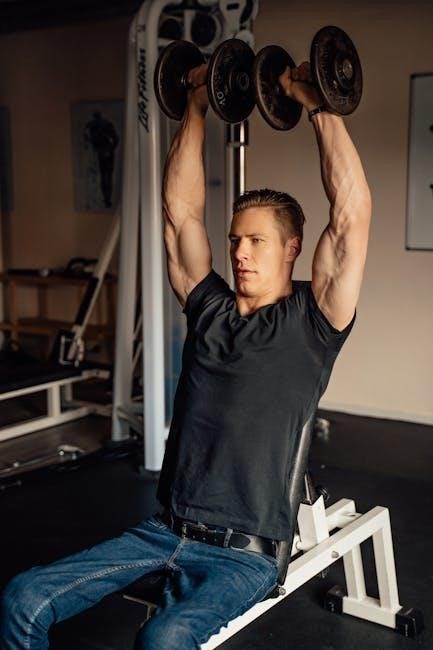
This phase prioritizes recovery while preserving muscle mass. Start with Shoulder Press (Barbell or Dumbbell) – 6 sets of 10-12 reps, selecting a weight that allows for good form. Follow with Lateral Raises – 6 sets of 12-15 reps, focusing on controlled movements. Rear Delt Flyes – 6 sets of 12-15 reps, will target the posterior deltoids.
For arms, perform Barbell Curls – 6 sets of 10-12 reps, and Triceps Pushdowns – 6 sets of 10-12 reps. Include Hammer Curls – 6 sets of 12-15 reps, and Overhead Triceps Extensions – 6 sets of 12-15 reps. Maintain 60-90 second rest intervals between sets. Reduced volume allows for muscle repair and prevents overtraining, setting the stage for future gains.
Exercise Selection for GVT
Prioritize compound movements like squats, deadlifts, bench press, and rows, supplemented with isolation exercises to target specific muscle groups effectively.
Best Exercises for Chest (GVT)
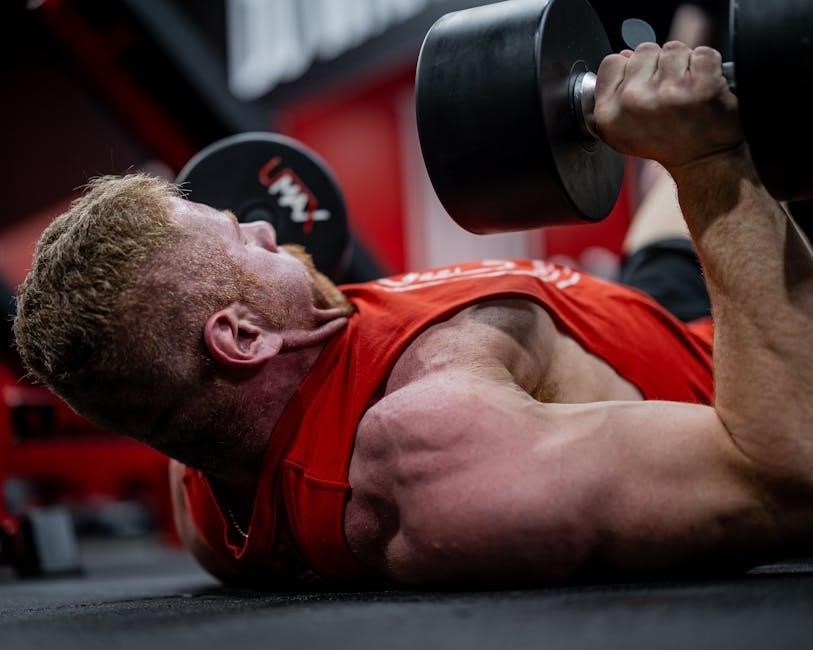
For maximizing chest development within a German Volume Training (GVT) framework, focus on exercises that allow for substantial weight loading and a full range of motion. The foundational movement should be the flat barbell bench press, enabling the heaviest loads for the 10×10 protocol.
Supplement this with incline dumbbell press to target the upper chest, and decline barbell press to hit the lower portion. Dumbbell flyes, performed after the heavier compound lifts, provide a stretching stimulus and enhance muscle fiber recruitment.
Consider incorporating cable crossovers for a finishing movement, focusing on peak contraction. Remember to maintain strict form throughout all sets, prioritizing controlled movements over sheer weight. Proper exercise selection is crucial for maximizing hypertrophy and minimizing injury risk during this high-volume approach.
Effective Exercises for Back (GVT)
Building a robust back with GVT requires a focus on compound movements that engage multiple muscle groups simultaneously. The cornerstone should be pull-ups (or lat pulldowns if pull-ups are not feasible), aiming for as many reps as possible within good form for each set.
Complement this with barbell rows, a classic exercise for overall back thickness. T-bar rows offer another excellent variation, allowing for a different angle of attack. Include seated cable rows to target the mid-back and improve posture.
Don’t neglect the lower back; incorporate hyperextensions or good mornings (with light weight) cautiously. Prioritize controlled movements and a full range of motion throughout each exercise. Proper form is paramount to prevent injury during this high-volume training style.
Optimal Exercises for Legs (GVT)
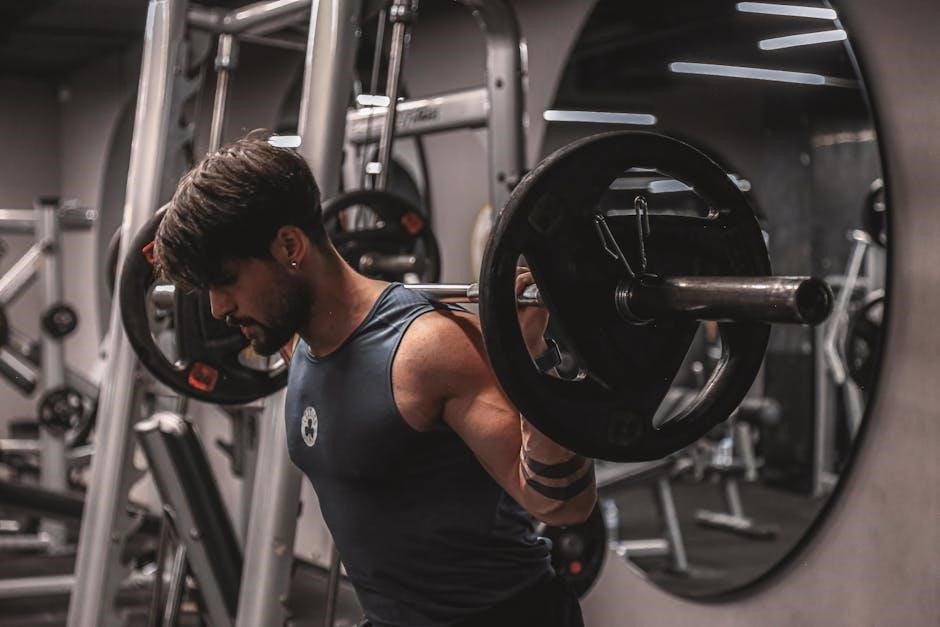
Leg day within a GVT framework demands exercises that effectively target the quads, hamstrings, and glutes. The foundation should be barbell squats – a true test of strength and a builder of overall leg mass. Prioritize depth and controlled descent.
Supplement squats with leg presses, allowing for a different stimulus and potentially higher volume. Romanian deadlifts (RDLs) are crucial for hamstring development, emphasizing the stretch under tension. Include leg extensions to isolate the quadriceps and hamstring curls for focused hamstring work.
Don’t overlook calf raises, either seated or standing, to complete the lower leg development. Remember to maintain proper form throughout all exercises, especially under fatigue, to avoid injury during this demanding protocol.
Shoulder and Arm Exercises for GVT
For shoulder development in GVT, prioritize compound movements alongside isolation work. Overhead presses (barbell or dumbbell) are fundamental for building overall shoulder strength and mass. Supplement with lateral raises to target the medial deltoids, contributing to shoulder width. Front raises focus on the anterior deltoids, completing balanced shoulder development.
Arm work should include both biceps and triceps exercises. Barbell curls and dumbbell curls are essential for biceps growth, while close-grip bench presses and overhead triceps extensions effectively target the triceps. Consider hammer curls for brachialis development.
Maintain strict form throughout all sets, even as fatigue sets in, to maximize muscle activation and minimize injury risk during this high-volume approach.

Important Considerations for GVT
Success hinges on proper nutrition and recovery strategies; GVT is demanding, so adequate protein intake and sufficient rest are absolutely critical for adaptation.
Nutrition for GVT Success
German Volume Training (GVT) dramatically increases your body’s nutritional demands. To support the intense volume and promote recovery, prioritize a diet rich in whole, unprocessed foods. Protein intake is paramount, aiming for approximately 1 gram per pound of bodyweight daily to facilitate muscle repair and growth.
Carbohydrates are equally important, providing the necessary energy to fuel your workouts and replenish glycogen stores. Opt for complex carbohydrates like brown rice, quinoa, and sweet potatoes. Don’t neglect healthy fats, which play a vital role in hormone production and overall health.
Hydration is also crucial; drink plenty of water throughout the day, especially before, during, and after training. Consider supplementing with creatine to enhance strength and power output. Timing your nutrient intake around your workouts – consuming a protein and carbohydrate-rich meal or shake post-workout – can further optimize recovery and results.
Recovery Strategies for GVT
Given the high volume of German Volume Training, prioritizing recovery is non-negotiable. Adequate sleep – aiming for 7-9 hours per night – is fundamental for muscle repair and hormonal balance. Active recovery, such as light cardio or stretching, can improve blood flow and reduce muscle soreness.
Consider incorporating foam rolling or massage to address muscle tightness and improve flexibility. Proper nutrition, as previously discussed, is also a key component of recovery. Don’t underestimate the importance of deload weeks, built into the 6-week plan, to allow your body to fully recuperate.
Managing stress levels is also crucial, as chronic stress can hinder recovery. Techniques like meditation or deep breathing exercises can be beneficial. Listen to your body and don’t push through pain; rest when needed to prevent injury and optimize your progress.
Who Should (and Shouldn’t) Try GVT?
German Volume Training is best suited for intermediate to advanced lifters with at least a year of consistent training experience. Individuals familiar with proper form and capable of handling significant training volume will benefit most. It’s an effective method for breaking plateaus and stimulating muscle growth, particularly for those who’ve stalled on traditional programs.
However, GVT isn’t ideal for beginners due to the high demands it places on the central nervous system and recovery capacity. Those with pre-existing injuries should proceed with caution or avoid it altogether. Individuals prone to overtraining or with limited recovery resources may also find it too taxing.
Prioritize a solid foundation of strength and technique before attempting GVT. If you’re unsure, consult with a qualified fitness professional to determine if it’s appropriate for your individual needs and goals.