
Geometry formulas, often found in PDF compilations, are crucial for various fields, enhancing accuracy and speed in calculations.
These maths formulas cover essential topics like number systems, percentages, and ratios, aiding CBSE Class 12 exam preparation.
What is Geometry?
Geometry, at its core, is the branch of mathematics concerned with the properties and relations of points, lines, surfaces, solids, and higher dimensional analogs. It’s a deeply historical field, originating in practical measurements concerning surveying and construction, and evolving into a highly abstract and theoretical discipline. Understanding geometric principles is fundamental to numerous scientific and technological advancements.
The study of geometry relies heavily on formulas – concise mathematical statements expressing relationships between different geometric elements. Accessing these formulas, often conveniently compiled in PDF format, is essential for students, engineers, and anyone working with spatial relationships. These resources, like those used for CBSE Class 12 preparation, provide a quick reference for calculating areas, volumes, angles, and distances. Furthermore, advanced concepts like those in symplectic geometry and quantum geometry build upon these foundational principles.
Geometry isn’t merely about memorizing formulas; it’s about developing spatial reasoning and problem-solving skills.
Why Use Geometry Formulas?
Geometry formulas are indispensable tools for solving a vast array of problems across diverse fields. They provide a standardized and efficient method for calculating properties of shapes, eliminating guesswork and ensuring accuracy. Whether preparing for a CBSE Class 12 exam or tackling complex engineering designs, these formulas are foundational.
The availability of geometry formulas in PDF format streamlines access and organization. These compilations, alongside textbook solutions, offer a readily available resource for quick reference and problem-solving. Advanced areas like rigid geometry and spectral algebraic geometry, while complex, still rely on these core principles.
Using formulas enhances speed, confidence, and precision in calculations. They are crucial for applications ranging from architectural design and computer graphics to physics and even quantum geometry, where defining spatial relationships is paramount.

Basic Geometric Shapes and Formulas
Geometry formulas, often available as PDF resources, cover triangles, quadrilaterals, and circles – foundational shapes for calculations and problem-solving.
Formulas for Triangles
Triangle formulas, frequently compiled in geometry PDF guides, are fundamental in mathematics and physics. Determining a triangle’s area is often the first step, utilizing the formula: Area = 1/2 * base * height. Calculating the perimeter is straightforward: Perimeter = side a + side b + side c.
However, the most iconic triangle formula is the Pythagorean Theorem, expressed as a² + b² = c², where ‘c’ represents the hypotenuse – the side opposite the right angle. This theorem is invaluable for finding unknown side lengths in right triangles.
These formulas, readily accessible in downloadable PDF format, are essential for students preparing for exams like the CBSE Class 12 board exams, ensuring accuracy and speed in solving geometric problems. Mastering these concepts builds a strong foundation for more advanced mathematical studies.
Area of a Triangle
Calculating the area of a triangle is a cornerstone of geometry, frequently detailed in comprehensive geometry PDF resources. The most common formula utilizes the base and height: Area = 1/2 * base * height. This requires identifying a base (any side of the triangle) and the corresponding perpendicular height.
However, when the height isn’t directly provided, alternative formulas come into play. Heron’s formula allows area calculation using only the lengths of the three sides: Area = √(s(s-a)(s-b)(s-c)), where ‘s’ is the semi-perimeter (half the perimeter);
These formulas, easily found in PDF compilations for exam preparation like CBSE Class 12, are vital for solving various geometric problems, enhancing accuracy and speed in mathematical calculations. Understanding these methods is crucial for a solid geometric foundation.
Perimeter of a Triangle
Determining the perimeter of a triangle is a fundamental geometric calculation, readily available within geometry PDF study guides. The perimeter, representing the total distance around the triangle, is simply found by adding the lengths of all three sides: Perimeter = a + b + c, where a, b, and c are the side lengths.
This straightforward formula is a core concept often emphasized in educational materials, including resources for exams like the CBSE Class 12 board examinations. Mastering this calculation builds a strong foundation for more complex geometric problems.
Geometry PDF compilations often present this alongside area formulas, reinforcing the interconnectedness of these concepts. Accurate perimeter calculation is essential for various applications, enhancing mathematical proficiency and problem-solving skills.
Pythagorean Theorem
The Pythagorean Theorem, a cornerstone of geometry, is extensively covered in geometry PDF resources. This theorem establishes a relationship between the sides of a right-angled triangle: a² + b² = c², where ‘c’ represents the hypotenuse (the side opposite the right angle), and ‘a’ and ‘b’ are the other two sides.
Understanding and applying this theorem is crucial for solving numerous geometric problems, and is often a key component of curricula like the CBSE Class 12 mathematics syllabus. Geometry PDF guides typically provide detailed explanations and worked examples to aid comprehension.
Its applications extend beyond pure mathematics, impacting fields like engineering and construction. Mastering the Pythagorean Theorem is fundamental for building a strong mathematical foundation and tackling advanced concepts.
Formulas for Quadrilaterals
Geometry PDF resources dedicate significant space to quadrilateral formulas, essential for calculating areas and perimeters. Quadrilaterals, four-sided polygons, include rectangles, squares, parallelograms, trapezoids, and kites, each with unique formulas.
The area of a rectangle is length × width, while a square’s area is side². A parallelogram’s area is base × height. These fundamental formulas are often included in CBSE Class 12 math preparation materials, available as downloadable PDF sheets.
More complex quadrilaterals require different approaches. Understanding these formulas is vital for solving geometric problems and is frequently tested in standardized exams. Comprehensive geometry PDF guides provide detailed explanations and practice problems to solidify understanding.
Area of a Rectangle
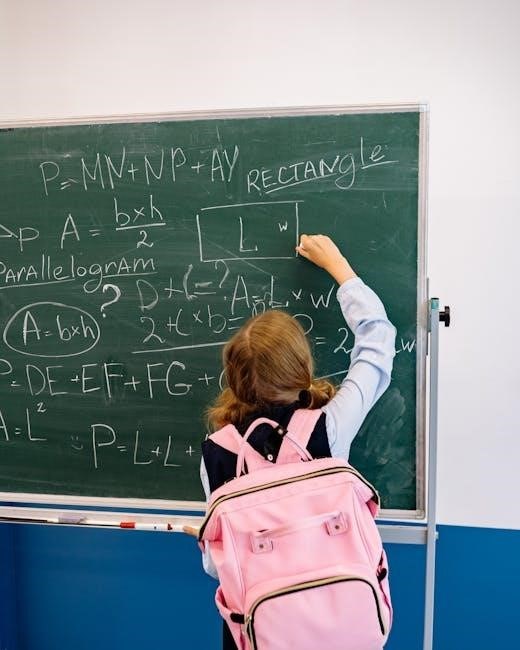
The area of a rectangle, a foundational concept in geometry, is calculated by multiplying its length by its width. This simple yet crucial formula – Area = Length × Width – is prominently featured in most geometry PDF resources and textbooks.
Understanding this formula is essential for CBSE Class 12 students preparing for board exams, as it forms the basis for more complex calculations involving other quadrilaterals and shapes. Numerous online geometry formula compilations offer clear explanations and examples.
PDF guides often include visual aids and practice problems to reinforce comprehension. Mastering the rectangle’s area calculation is a stepping stone to grasping concepts in coordinate geometry and trigonometry, as detailed in advanced geometry PDFs.
Area of a Square
Calculating the area of a square is a fundamental skill in geometry, readily available in comprehensive geometry PDF guides. Since all sides of a square are equal, its area is determined by squaring the length of one side – Area = Side × Side (or Side2).
This formula is a cornerstone for CBSE Class 12 students, frequently tested on board examinations, and is clearly outlined in numerous online geometry formula compilations. These resources often provide step-by-step solutions and illustrative examples.
PDF documents dedicated to maths formulas emphasize the square’s area as a building block for understanding more complex shapes and concepts, including those found in coordinate geometry. Mastering this formula boosts accuracy and speed in problem-solving.
Area of a Parallelogram
Determining the area of a parallelogram is a key concept within geometry, frequently detailed in accessible geometry PDF resources. Unlike squares or rectangles, parallelograms don’t necessarily have right angles. The formula for its area is Area = Base × Height. Crucially, the height must be perpendicular to the base.
Many maths formulas PDF guides emphasize this distinction, providing diagrams to illustrate the correct height measurement. This concept is vital for CBSE Class 12 students preparing for board exams, where accurate application of formulas is essential.
Online geometry formula compilations often include practice problems to solidify understanding. Mastering the parallelogram’s area lays the groundwork for calculating areas of more complex polygons and understanding related concepts in coordinate geometry.
Formulas for Circles
Circles are fundamental shapes in geometry, and their formulas are readily available in comprehensive geometry PDF guides. Two primary measurements define a circle: its area and circumference; The area, representing the space enclosed within the circle, is calculated using the formula Area = πr², where ‘r’ denotes the radius.
The circumference, or the perimeter of the circle, is found using Circumference = 2πr or, equivalently, Circumference = πd, where ‘d’ is the diameter. These maths formulas are essential for CBSE Class 12 students and are frequently tested.
Numerous online geometry formula compilations provide visual aids and step-by-step examples. Understanding these formulas is crucial for tackling problems involving sectors, arcs, and related geometric constructions.
Area of a Circle
Determining the area of a circle is a cornerstone of geometric calculation, frequently detailed within geometry PDF resources. The formula, Area = πr², elegantly defines the space enclosed within the circle’s boundary. Here, ‘π’ (pi) represents the mathematical constant approximately equal to 3.14159, and ‘r’ signifies the circle’s radius – the distance from the center to any point on the circumference.
Mastering this formula is vital for CBSE Class 12 students preparing for board exams, as it appears in numerous problem sets. Online geometry formula compilations often provide illustrative examples and practical applications.
Understanding the relationship between radius, diameter, and area is key to successfully applying this fundamental maths formula.
Circumference of a Circle
Calculating a circle’s circumference – the distance around its perimeter – is another fundamental skill detailed in comprehensive geometry PDF guides. The formula, Circumference = 2πr or C = πd, provides a straightforward method for this calculation. Here, ‘π’ remains the constant approximately equal to 3.14159, ‘r’ denotes the radius, and ‘d’ represents the diameter (twice the radius).
This formula is essential for CBSE Class 12 students and is frequently tested on board examinations. Numerous online geometry formula compilations offer step-by-step solutions and real-world applications.
Grasping the connection between circumference, radius, and diameter is crucial for effective problem-solving using this core maths formula.
3D Geometry Formulas
Geometry PDF resources detail formulas for 3D shapes like cubes, spheres, and cylinders, calculating volume and surface area with precision.
Volume of a Cube
Understanding the volume of a cube is fundamental in three-dimensional geometry, and readily available in comprehensive geometry PDF resources. A cube, by definition, possesses six equal square faces, with all edges having the same length. Determining its volume is a straightforward process, crucial for various applications ranging from basic mathematical problems to real-world scenarios like calculating the capacity of containers or the amount of material needed for construction.
The formula for calculating the volume (V) of a cube is elegantly simple: V = s³, where ‘s’ represents the length of one side of the cube. This means you multiply the side length by itself three times. For instance, if a cube has a side length of 5 cm, its volume would be 5 cm * 5 cm * 5 cm = 125 cubic centimeters (cm³). Geometry formula PDFs often provide visual aids and worked examples to illustrate this concept, making it easier to grasp for students and professionals alike. Mastering this formula is a stepping stone to understanding more complex 3D geometric calculations.
Volume of a Sphere
Calculating the volume of a sphere is a key concept in 3D geometry, frequently detailed within geometry PDF study guides. A sphere, defined as a perfectly round geometrical object in three dimensions, requires a specific formula to determine the amount of space it occupies. This calculation finds applications in diverse fields, including physics, engineering, and even everyday life – for example, determining the volume of a ball or a spherical tank.
The formula for the volume (V) of a sphere is V = (4/3)πr³, where ‘π’ (pi) is a mathematical constant approximately equal to 3.14159, and ‘r’ represents the radius of the sphere. The radius is the distance from the center of the sphere to any point on its surface. Geometry formula PDFs often emphasize the importance of using the correct units (cubic units) when expressing volume. For example, if a sphere has a radius of 3 cm, its volume would be (4/3) * 3.14159 * (3 cm)³ ≈ 113.1 cubic centimeters (cm³).
Volume of a Cylinder
Determining the volume of a cylinder is a fundamental skill in geometry, comprehensively covered in most geometry PDF resources. A cylinder, characterized by two parallel circular bases connected by a curved surface, requires a distinct formula to calculate the space it encloses. This calculation is vital in numerous practical applications, such as determining the capacity of storage tanks, pipes, or even common household items like cans.
The formula for the volume (V) of a cylinder is V = πr²h, where ‘π’ (pi) is approximately 3.14159, ‘r’ represents the radius of the circular base, and ‘h’ denotes the height of the cylinder. Geometry formula PDFs consistently highlight the necessity of employing consistent units – typically cubic units – when reporting volume. For instance, if a cylinder possesses a radius of 2 inches and a height of 5 inches, its volume would be 3.14159 * (2 inches)² * 5 inches ≈ 62.83 cubic inches (in³).
Surface Area of a Sphere
Calculating the surface area of a sphere is a core concept within geometry, readily accessible through numerous geometry PDF guides and compilations. A sphere, defined as a perfectly round geometrical object in three-dimensional space, presents a unique calculation compared to other shapes. Understanding this formula is crucial in fields like physics, engineering, and even everyday applications involving spherical objects.
The formula for the surface area (SA) of a sphere is SA = 4πr², where ‘π’ (pi) is approximately 3.14159 and ‘r’ represents the radius of the sphere. Geometry formula PDFs emphasize the importance of using consistent units, resulting in square units for the surface area. For example, if a sphere has a radius of 3 centimeters, its surface area would be 4 * 3.14159 * (3 cm)² ≈ 113.10 square centimeters (cm²). Mastering this formula, often found in concise PDF formats, is essential for problem-solving.
Surface Area of a Cylinder
Determining the surface area of a cylinder, a fundamental geometric shape, is frequently detailed within comprehensive geometry PDF resources. Cylinders, characterized by two parallel circular bases connected by a curved surface, require a slightly more complex calculation than spheres. These PDF guides often break down the calculation into its component parts for clarity.
The total surface area (TSA) of a cylinder is calculated using the formula: TSA = 2πrh + 2πr², where ‘r’ is the radius of the circular base, ‘h’ is the height of the cylinder, and ‘π’ (pi) is approximately 3.14159. The first part, 2πrh, calculates the lateral surface area (the curved side), while 2πr² calculates the area of the two circular bases; Consistent units are vital; the result will be in square units. A cylinder with a radius of 2 cm and a height of 5 cm would have a TSA of 2 * 3.14159 * 2 cm * 5 cm + 2 * 3.14159 * (2 cm)² ≈ 87.96 cm². Accessing these formulas via geometry PDFs streamlines learning.

Advanced Geometry Concepts & Formulas
Geometry PDF resources extend beyond basics, introducing trigonometry and coordinate geometry, including sine, cosine, tangent, distance, and midpoint formulas.
Trigonometry, a core branch of advanced geometry, explores relationships between angles and sides of triangles, often detailed within comprehensive geometry PDF guides. These resources present fundamental concepts like the sine, cosine, and tangent functions – essential tools for solving problems involving right triangles.
Understanding these functions, and their inverses, is paramount. Sine is defined as the ratio of the opposite side to the hypotenuse, cosine as the adjacent side to the hypotenuse, and tangent as the opposite side to the adjacent side.
Geometry PDF materials frequently include trigonometric identities, which are equations that hold true for all values of the variables involved. These identities are invaluable for simplifying expressions and solving complex trigonometric equations. Further exploration delves into the unit circle, radian measure, and applications in fields like navigation, surveying, and physics, all readily available in detailed formula sheets.
Sine, Cosine, and Tangent
Sine (sin θ), Cosine (cos θ), and Tangent (tan θ) are foundational trigonometric ratios, extensively covered in geometry PDF resources. These ratios define relationships within right-angled triangles, relating angles to side lengths. Specifically, sin θ = Opposite/Hypotenuse, cos θ = Adjacent/Hypotenuse, and tan θ = Opposite/Adjacent.
Geometry PDF guides often present these alongside their reciprocal functions: Cosecant (csc θ), Secant (sec θ), and Cotangent (cot θ). Mastering these ratios is crucial for solving various geometric problems, including angle calculations and side length determinations.
Furthermore, these functions extend beyond right triangles through the unit circle definition, enabling calculations for any angle. PDF formula sheets typically include key identities involving sine, cosine, and tangent, facilitating simplification and problem-solving in advanced applications like wave analysis and vector calculations.
Coordinate geometry bridges algebra and geometry, utilizing a coordinate system – typically Cartesian – to represent geometric shapes with algebraic equations. Comprehensive geometry PDF resources dedicate sections to this crucial field, detailing how points are defined by coordinates (x, y) and lines are represented by equations like y = mx + c.
Key concepts within geometry PDF guides include calculating distances between points and finding midpoints of line segments. These calculations rely on fundamental formulas: the Distance Formula and the Midpoint Formula. Understanding these allows for precise analysis of geometric figures.
These PDF materials often extend to circles, parabolas, and other conic sections, expressed algebraically. Coordinate geometry is vital for applications in computer graphics, engineering, and physics, making its formulas essential for students and professionals alike.

Distance Formula
The Distance Formula, a cornerstone of coordinate geometry detailed in most geometry PDF resources, calculates the distance between two points in a coordinate plane. Given two points, (x1, y1) and (x2, y2), the formula is:
d = √[(x2 ⏤ x1)2 + (y2 ⏤ y1)2]
Essentially, it’s a direct application of the Pythagorean theorem. Geometry PDF guides often illustrate this with visual examples, showing how the difference in x-coordinates and y-coordinates form the legs of a right triangle, with the distance being the hypotenuse.
Mastering this formula, readily available in geometry PDF compilations, is crucial for solving problems involving lengths, perimeters, and areas within coordinate systems. It’s a foundational element for more advanced geometric concepts and applications.
Midpoint Formula
The Midpoint Formula, frequently found within comprehensive geometry PDF study guides, determines the coordinates of the midpoint of a line segment. Given two endpoints, (x1, y1) and (x2, y2), the midpoint (M) is calculated as:
M = ((x1 + x2)/2, (y1 + y2)/2)
This formula simply averages the x-coordinates and the y-coordinates of the two endpoints. Many geometry PDF resources visually demonstrate this concept, showing the midpoint as the point exactly halfway between the two given points on a coordinate plane.
Understanding the Midpoint Formula, easily accessible in geometry PDF materials, is vital for problems involving symmetry, coordinate proofs, and finding the center of geometric shapes. It’s a fundamental tool in coordinate geometry.
Resources for Geometry Formulas (PDFs)
Geometry PDF compilations and textbook solutions offer readily available formulas. Online resources provide convenient access to essential geometry formulas for quick reference.
Online Geometry Formula Compilations

Numerous websites offer comprehensive geometry formula compilations in PDF format, serving as invaluable resources for students and professionals alike. These online collections typically categorize formulas by shape – triangles, quadrilaterals, circles, and three-dimensional figures – facilitating easy navigation and quick access to needed information.
Many educational platforms and math-focused websites host these compilations, often providing interactive tools alongside the formulas. Some sites even offer step-by-step solutions to practice problems, reinforcing understanding and application. The availability of these resources is particularly beneficial for exam preparation, like the CBSE Class 12 Maths board exam, where quick recall of formulas is essential.
Furthermore, these online resources are frequently updated to reflect the latest mathematical conventions and standards. They often include formulas related to advanced concepts like trigonometry and coordinate geometry, expanding their utility beyond basic geometric calculations. Accessing these PDFs is generally free, making them accessible to a wide audience.
Textbook Solutions and Formula Sheets
Alongside online compilations, geometry formulas are readily available within textbook solutions and dedicated formula sheets, often in PDF format. These resources are particularly useful for students following a specific curriculum, as they align directly with the concepts taught in class.
Textbook publishers frequently provide supplementary materials, including formula sheets, to aid student learning and exam preparation. These sheets typically summarize key formulas for each geometric shape and concept, offering a concise reference guide. Solutions manuals often demonstrate the application of these formulas in solving various problems, enhancing understanding.
Many websites dedicated to providing homework help and textbook solutions also offer downloadable PDFs containing essential geometry formulas. These resources can be invaluable for students preparing for exams like the CBSE Class 12 Maths board exam, ensuring they have quick access to the necessary tools for success.